

“Mithila painting” is an umbrella term for ritual and art forms practiced in Northern Bihar, India, and in Nepal’s Terai. The paintings began as auspicious images of gods and goddesses painted by upper-caste women on the interior walls and floors of their homes. They grew out of specific aesthetic principles, styles, images, and settings (Rekha 2004; Brown-Heinz 2006; Fleury 2020, 153). In 1966–1967, when the All-India Handicrafts Board urged Mithila women to paint on paper for sale to earn income for their drought-stricken families, the central government sought to commercialize handicrafts for national development and highlighted Indian handicrafts at World Fairs. In the process, the painting tradition underwent significant changes, including new pigments and tools, thematic diversification, emergence of new styles, and recognition of individual artists’ identity, as well as its commercialization (Fleury 2018, 217). Marketing of the art brought transnational cultural mediators to India to purchase the paintings and sell them during a period of Indophilia in Europe, the USA, and Japan. The transfer of paintings from domestic walls for ritual purposes to paper as commodities coincided with the arrival of transnational mediators committed to reducing economic hardship by promoting the paintings as artworks, thus reconfiguring an essentially local cultural field into a transnational one (Fleury and Ehrhardt 2025).
Over time, interactions among the artists and the mediators circulating the paintings worldwide reshaped them through categorizations external to Mithila: from ritual to folk, to contemporary art, and from local, to national, to global scales. Despite these changes, as well as expanded styles, settings, images, and audiences, artists have retained a commitment to aesthetic characteristics and praxis ensuring Mithila painting’s recognizability and distinctiveness.
This study aims to demonstrate how the international circulation of paintings resonates with the development of global, particularly Western, feminisms in the 1970s and contributes to a discourse shift based on women painters’ heroization. This is evidenced by their designation as identification figures by the United Nations during International Women’s Year in 1975 and by two Western avant-garde feminist periodicals in 1977–1978.
The construction of charismatic, projective identification figures embodying Indophilia and feminism in the 1970s contributes to opening up the field of (countercultural) possibilities (Sartre 1968; Bourdieu 1980, 104) by writing a horizon personified by the “force of the example” (Merklé 2007, 317). Women painters embody a new exemplary posture, contributing to the emergence of artistic and gendered alternatives, breaking with dominant norms, but in tune with a countercultural, anti-authoritarian, and dissenting Zeitgeist (“spirit of the age”) characteristic of these critical years[1] and their dissonant interpretative schemes. The construction of charismatic and prophetic figures epitomizes an antidote to the globalized art world, combined with technocratic capitalism and patriarchy. In a dialectic between subalternization and assertions of identity in resonance with the countercultural feminist perspectives of Renata Stendhal and Erika Moser-Schmitt, women painters draw their charisma from the proof they provide—through their creative act circulating globally on the contemporary scene—of the existence of alternatives to the peripheralization undergone in the art world and to the arbitrariness of dominant norms.
The valorization and even “heroization” of feminist painters’ icons aim to break through the “symbolic barrier of the threshold” (barrière symbolique du seuil; Bourdieu 1993, 33) and introduce Mithila art into an elitist and normative art scene. Valorized as charismatic figures, Mithila artists are made to stand in for artistic gendered and social changes. They are seen to embody the subversion and reversal of a social and artistic model that is patriarchal and ethnocentric, and the valorization of (feminist and countercultural) norms associated with an art of resistance.
Rethinking Mithila Studies: How Feminisms Heroized Women Painters in the 1970s
The networks of transcultural mediators involved in the “artification” (multifaceted process of transforming non-art into art; Shapiro 2012, 20) and global circulation of Mithila art exemplify the situation in the field of Mithila Studies. They position themselves within a contemporaneous field long dominated by upper-caste male scholars, who have tended to favor specific forms of historical and artistic knowledge production within a patriarchal context. This domination of male scholars additionally has made invisible the contributions of Maithil women and lower-caste communities. Yet over the last decades, Mithila art, initially mostly produced by women, has acquired worldwide renown and spawned a few celebrities and a new class of artists, empowered by forms of socioeconomic resources and women’s emancipation.
Moser[-Schmitt] (1988) and Brown-Heinz (2006) concur that the emergence of a new class of artists and a minority of “star” figures is a consequence of commodification and artification. International celebrities emerge through an elitist process restricted to the aesthetic approaches of artists selected on exogenous criteria. The rise of a new class of painters and this “starification” represent a factor of inequality marked by disparities in status and income, and the relegation of the majority of painters to strategies of socioeconomic survival. The transition to art and its insertion into a globalized market confer unprecedented recognition on painters and their work. It brings a gain in market value and aesthetic appreciation, even enabling some artists to achieve real forms of symbolic consecration. However, this is only a minority of them. According to Brown-Heinz (2006, 18),
I turn to the social system of that world as it created a class of artists, . . . attempted to professionalize them and . . . turned some into international celebrities; continued to develop a discourse of artwriting about the art; and established a system of circulation and exchange for the art. The movement from wall to paper has had enormous consequences. . . . It has brought income into a deeply impoverished part of Bihar; it has provided a source of income to women who . . . had none, especially women of high caste; it raised a cultural product of women in a highly patriarchal society to national and international esteem; it empowered women by giving widows a means of independence and wives a source of prestige to which husbands had to make adjustments; it drew foreigners with . . . interests in the culture to a part of Bihar that had scarcely seen a European since the British departed; it detached the art from its . . . ritual meanings by catering to the tastes of foreign buyers with limited curiosity about its significance . . . ; and it turned a handful of women artists into international celebrities.
The family and social emancipation generated by the artification through the market is combined with the persistence of gendered inequalities. A complex interplay of empowerment, resistance, and exploitation is experienced by painters in relation to the global turn of their art and the structures of domestic patriarchy (Marchand and Runyan quoted by Fuller and Narasimhan 2007, 191).
The history of the commercialization and global reception of Mithila paintings provides an opportunity to revisit Mithila Studies from a critical perspective, allowing for the demarginalization of women painters and their works. This is evidenced in a historical and sociological context toward understanding the struggles among interests (for example, caste- and gender-based, economic, and political). As such, the field of Mithila art resonates with a critical approach to Mithila Studies, delving into topics such as the exclusions—and potential (re)instatement—of women’s creative expressions into the canons of Indian and global art, as well as the cultural appropriation and authenticity of feminist debates in South Asia and beyond. In addition, Maithil paintings are linked with concurrent narratives from their place of production and when received on the global stage. This is the case when the global circulation of the paintings induces their re-semantization[2] according to plural discourses of the moment. Some of these discourses even broaden the “connected history” (Subrahmanyam 2022) of this artification.
At the juncture of these intertwined discourses in a connected history, a transcultural process of valorizing—or even heroizing—Mithila women painters emerged from 1975 onward. Despite their relegation to a primitivist anonymity, these artists were elevated to heroines during the UNESCO’s International Women’s Year. They were also used as significant—albeit reinterpreted—references for two avant-garde feminist magazines EMMA and Heresies during the Long Global Sixties.[3]
The review of Mithila women in these magazines demonstrates the extent to which the reception of Mithila art in the 1970s in the West was connected to the history of feminism. Stakeholders of this feminist hermeneutics were the French writer Yves Véquaud (1938–2000)—via his speculations on a matriarchy (Véquaud 1973, 72 and 75; Véquaud 1976, 16; Luneau and Segarra 1974), reappropriated in EMMA by the German writer exploring feminist themes, Renate Neumann, also known as Renata Stendhal (born 1944)—and the German art ethnologist (Kunstethnologin) Erika Moser-Schmitt (1936–1994), as a pioneer of women’s and feminist studies, as will be discussed later.
EMMA and Heresies are two journals that are representative of distinct trends within radical feminism in the 1970s, respectively, in their exclusive (attending to binary gender dynamics) and inclusive conceptions (attending to the intersections of oppressions, such as those based on caste, class, religion, and geopolitical hierarchies). Stendhal, drawing on Véquaud’s utopia, and Moser-Schmitt—in their distinctive approaches to the Mithila painters—offer two views of feminism, combined with divergent relationships to the field: the first indirect, based on Véquaud’s ethnographic approximations, and the second direct, based on the fieldwork and the making of anthropological documentaries. However, both visions bear witness to a kaíros (opportune moment) of international reception, not only of the works but also of the Mithila painters, considered as pioneering figures of women artists in the wake of the 1970s countercultural Indophilia. In the course of heroization, female painters entered an international art scene and were reappropriated by contemporaneous feminists. The rise of the counterculture and the radical feminisms linked to it valorize a political, aesthetic, theoretical, and ethical innovation (Gobille 2018, 370) that was propitious to a greater recognition of the art of Maithil painters as dissociated from the canons of the mainstream art scene, and embodying an ambition for social renewal and subversion of the norms of the Western art world.
These feminist appropriations of the painters and their works, together with other forms of transnational mediation and the painters’ own role in the artification and dissemination of Mithila art, illustrate the globalized reception of Mithila art discussed here. In the wake of this global turn, the social, aesthetic, and economic mutations brought about by artification raise the issues of cultural appropriation and authenticity in feminist debates on Mithila in and beyond South Asia and concerning the exclusion—and the (re)instatement—of Maithil women’s creative expressions into the canons of (Indian and non-Indian) contemporaneous art.
In the 1970s, an early form of inclusive or intersectional feminism (defined by consideration of simultaneous forms of oppression) emerged in Europe and India from studies on women painters’ status. Moser[-Schmitt] (1977–1978, 1978, 1988) analyzed artistic life and creative gestures in Mithila, mobilized by ritual wall frescoes and commercial works on paper, particularly those of Dalit women painters. These are situated at the conjunction of criteria of subalternization, defined as a relational process that marginalizes dominated and exploited groups (including those based on gender, caste, class, and divisions between rural and urban communities, and North and South).[4] The relationship of subalternization is one of simultaneous mobilization and domestication, producing exploitation. Society “performs” subalternization, or constitutes the very form in which it is realized as enduring social and political relations embedded in institutions and practices. Concerning Moser-Schmitt, the complex situation arising from the combination of subalternization criteria helped to catalyze an inclusive feminism attentive to a confluence of struggles and constituting a precursor to what later was recognized as “intersectional” feminism.
This intersectional theory, coined by Kimberle Crenshaw (1989) in her research on Black women, analyzes the position of women trapped within overlapping subordination systems (for example, race, class, and caste). These women are located at the margins of movements that strive against particular types of oppression, such as feminism, antiracism, and class and caste struggles. Intersectionality has also been applied in Indian feminism, especially as a critique of feminisms rooted in Brahmanism (the birth-based supremacy of dominant castes over the non-dominant ones) that paradoxically tends to perpetuate caste-based endogamous hierarchy, generating discriminations and exclusions. Moser-Schmitt precociously considered the intersectional category of Dalit women and others from non-dominant castes, by grasping the complexity of their multiple oppressions. She focused not only on patriarchy, but also on caste, class, and religious discrimination to shift the perspective of looking at prejudice beyond the exclusionary and binary outlook of gender-based feminism within an anti-caste framework. Her pioneering analysis (Moser[-Schmitt] 1977–1978, 107) considers the imbrications of domination criteria to focus on individuals whose multiple identities intersect, interact, and compete, whose issues can only be addressed through intersectionality.
The proto-intersectionality devised by Moser-Schmitt highlights the implications of caste, class, and religion in the debate on gender equality. Intersectionality theories developed from the groundwork of proto-intersectional thinkers—such as Moser-Schmitt, the Heresies Editorial Group, or the Combahee River Collective—who articulated intersections and power relations of identity categories. Their proto-intersectionality asserted the production of oppressions triggered by these intersecting identities. Racism, sexism, and class domination were recognized and combated as mutually reinforcing systems of oppressions.
The women of the Combahee River Collective first used the language of “interlocking systems” of oppression and privilege to define their experience:
The most general statement of our politics at the present time would be that we are actively committed to struggling against racial, sexual, heterosexual, and class oppression, and see as our particular task the development of integrated analysis and practice based upon the fact that the major systems of oppressions are interlocking. . . . We realize that the liberation of all oppressed peoples necessitates the destruction of the political-economic systems of capitalism and imperialism as well as patriarchy. (Combahee River Collective 1997)
Meeting since 1974, this Black feminist lesbian collective criticized Heresies for the exclusion of African American artists in its Fall 1977 issue, devoted to Lesbian Art and Artists. In the Winter 1977–1978 issue of the same journal, which also features Moser-Schmitt’s article on Mithila, the Combahee River Collective’s letter is reproduced, stating that “feminist and lesbian politics and creativity are not the exclusive property of white women” (Heresies Editorial Group 1977–1978c, 129). In their response, the Heresies Editorial Group expressed puzzlement due to their limited knowledge of artists or Third World lesbian communities. Two journal issues responding to this concern were issue 8 (Third World Women. The Politics of Being Other, Heresies Editorial Group 1979) and issue 15 (Racism Is the Issue, Heresies Editorial Group 1982). Despite their divergent positions, Moser-Schmitt, the Heresies editorial board, and the Combahee River Collective all represented different stages of an early intersectionality in progress. They advocated for an inclusive proto-intersectional feminism, situated within a collective climate of revolt and emancipation embedded in the Long Global Sixties’ counterculture, which sought to uncover the arbitrary foundations of the social order to overthrow it.
Even though Mithila paintings are predominantly created by women, the connection between them and feminist discourses was not immediately obvious. Rather, this discursive connection is the result of a long and ongoing process, in conjunction with commercialization. This nexus between proto-intersectional feminism and Mithila art is tied to discursive shifts prompted by the reception and globalized circulation of the paintings as commodities.
Discursive Shifts About Mithila Paintings: Toward a Postcolonial Inclusive Feminism?
While the paintings began as auspicious images drawn and colored by women on the walls and floors within domestic spaces, during the Bihar drought and famine, the All-India Handicrafts Board encouraged shifting the artwork onto paper for income generation, causing social and aesthetic changes, along with its global commercialization.
This globalization coincides with the rise of postcolonial feminist and gender studies, wherein scholars have critiqued patriarchy, female infanticide, arranged marriages, and bride burning, while also rejecting male Westerners’ interpretations of Asian art. In accordance with the Zeitgeist, since the late 1980s painters have integrated into their works elements challenging dominant narratives, including those rooted in masculinity. Thus, the themes of Mithila paintings became increasingly secular, inspired by political commitment and women’s narratives about their own environments. Davis (2014), for example, examines how women express the pain of struggling with patriarchy and the seclusion of pardā,[5] which involves subordination based on class and caste, while analyzing folktales and paintings that reveal such contemporary developments. Simultaneously, traditional folktales and paintings—as pictorial narratives—bear witness to women’s resistance to the multiple criteria of social subordination.
This shift in the narratives converges with a critical examination—first in scientific writings, but more decisively in artistic narratives and performances—of gender relations and patriarchal and caste-bound norms in Mithila, uncovering intersections of domination systems based on gender, caste, and class. The themes chosen by painters are adapted to meet the preferences of a global audience. The works attract attention for their aesthetic appeal and the discourses that resonate with feminist and anti-oppression struggles. Transnational mediators circulate Mithila paintings throughout the world, integrating them into what Sanjay Subrahmanyam (2022) terms “connected history.” This section highlights a prevailing tendency in the discussion surrounding these paintings, tracing the shift from late colonization to post-independence, and from a male-centric focus to an inclusive feminist perspective.
Even as the evolution of Mithila art belongs to a connected history involving transnational mediators, the paintings have been essentialized for a long time as anonymous, homogeneous, rural, and immemorial. The interactions among the artists and the transnational mediators reshaped the cultural field of Mithila art by redefining the paintings through recursively primitivist categories external to Mithila. The paintings were drawn into new settings to fit into economic, cultural, and ideological needs of outsiders. This process contributed to an urban, essentialized (both Indian and non-Indian) vision of Mithila art close to a primitivist and romantic tendency to exoticize rural India, based on a timeless character within a precapitalist holistic community. The paintings were essentialized as homogeneous, stable, and rural, and as an immemorial expression of Hindu women’s rituals.
Before commodification, integrated into caste-specific rituals, the domestic ritual wall paintings had no monetary value and did not circulate as commodified objects. Additionally, Mithila art was a ritual that played a subaltern role. As a women’s, non-Sanskritic, and non-written element of the ritual, murals, aripanas,[6] and objects were marginal to male Brahmanical religious values. Despite their subalternization in the ritual context of India, these paintings incidentally awakened the Western gaze, which in turn prolonged modes of formal distancing, often reifying the detachment of receivers from the cultural context in which the paintings were situated.[7] After the 1934 Nepal–India earthquake, William G. Archer’s[8] first glimpse of the paintings on the interior walls of damaged homes aroused deep aesthetic emotion. Excited by these paintings and the so-called parallels he saw to modern European art, he documented them, guided by upper-caste male informants. The characteristics underlined in his article titled “Maithil Painting” (W. Archer 1949) are linked to modernism—taste for distortions, search for color intensity, distance from Western canons—and are not free from primitivist schemes. Even if the reception of his 1949 article reified a vision of Mithila art based on a stylistic distribution according to caste and as a collective, anonymous women’s practice, he was himself less essentialist than he seemed,[9] just as his wife was, but she was recurrently made invisible and marginalized in their common and cooperative work.[10] Primitivist schemes persist in Véquaud’s writings as well, in his case through a countercultural and romantic myth. He positioned Mithila art at the heart of a timeless village utopia, since his nostalgia for a Heimat (“homeland” in German) cast Mithila as a Lost Eden (Fleury 2020, 162–63). He presented painters as prophetic figures within a matriarchal counter-society. The idea was spread through the international dissemination of his publications, in particular in the Air France magazine Atlas (Véquaud 1973), his essay L’art du Mithila (Véquaud 1976, 1977a, 1977b) and an article in Portfolio Magazine (Véquaud 1980), but also via Renata Stendhal in EMMA (Stendhal 1977).
Within applied anthropology and area studies, a discourse valuing subaltern minorities simultaneously emerged through Moser-Schmitt, the American ethnologist Ray Owens (1934–2000), and the ethnomusicologist Naomi Owens (1937–1997). Their promotion of a fair-trade system was notably articulated by Ray Owens as a framework for social justice as follows:
Whatever work Gauri Mishra and I have been able to accomplish in opening regular export markets for Mithila art and development work among artists, has been built upon the base of their work . . . . Our joint effort has been to try to protect painters from . . . bazaar mentality commercialization. This is a process in which middlemen, with no inherent appreciation for the art or culture, buy what seems to be selling at the cheapest possible price. . . . Gauri and I agreed to try, on a non-profit basis, to assist artists with marketing, paying on the basis of quality . . . . Our system pays an advance price to artists equivalent to the best price they can receive in India, and then when the painting is sold in America the artist receives a fixed percentage of the final selling price, less the advance. The final price paid to artists has on the average increased 600% since 1977. . . . A percentage of the final selling price of paintings has been reserved for development projects. The first of these is a literacy program in Maithili. (Owens 1983, 24)
As seen previously, Moser-Schmitt’s contribution on Mithila artists in Heresies, an experimental journal,[11] asserted a radical inclusive and proto-intersectional feminism. She also developed a pioneering analysis of the notion of spontaneous, generalized creativity as the crystallization of a denial of gender and primitivist stereotypes, which associate art and creativity with a Western, masculine monopoly. She formalized a critical approach to primitivism combined with an inclusive feminism. She discerned the superimposition of criteria of subalternization as she studied the creativity at work among Maithil painters, considering their caste affiliation. Right from the start of her contribution to Heresies, Moser[-Schmitt] (1977–1978, 107) integrates caste and class issues into the critique of patriarchy, when she addresses the construction of the artistic careers of women painters. Her combination of caste, class, and gender criteria of subalternization complexified her ethnography of the Mithila painting community. According to her, Brahmin women had a threefold advantage over their counterparts in the scheduled classes: they belong to an “elite sociocultural stratum,” there were fewer of them, which reduced rivalries in the artistic field, and they had more free time to develop their art, although they were more strictly subject to the constraint of pardā. Their seclusion, less systematically observed today, was a limitation of possibilities, including creative ones. This isolation also generated, a priori, a greater quota of available time than for Dalit women, who were forced into precarious employment and survival logics, which took precedence over patriarchal gender imperatives. Moser-Schmitt’s inclusive feminism is still relevant today, embodying an unprecedented convergence of subalternization modes as well as the struggles against them.
As an “activist ethnologist,” Moser-Schmitt contributed to the assertion of Dalit women’s identity via art. Filming, representing, and thinking about women’s creativity contributes to thwarting gender, caste, and class inequalities. Inclusive feminism also emerged early in India, for instance, with Women’s Quest for Power (Jain et al. 1980). The woman painters of the Madhubani district are among the five case studies covered in this book, which highlights their transformation of the traditional art of wall and floor painting into income within an export-oriented program promoted, in particular, by the Indian government. While the comparative sociological approach in Women’s Quest for Power integrates the Mithila paintings into a meta-analysis, focusing on the development processes of women confronted with precariousness, the case study on Mithila art is precisely documented by Nalini Singh and based on field data as evidenced by the list of contributors in the acknowledgments of the book. These contributors include a wide range of key players involved in the reception of Mithila art, such as, significantly, Moser-Schmitt.[12] This at least suggests that the authors were aware of the commitment of these mediators, with whom they may have discussed the Mithila art situation in the field. In Women’s Quest for Power, the study of the commercialization of Mithila paintings in India is addressed, without consideration of its artistic dimension, into a diversified study on development issues faced by women living in extreme poverty, including street sellers, milk producers, papadum makers, and night patrollers. The book analyzes how economic practices, cooperative modes of production, and collective action operate among low-income women within a deeply stratified society.
If the commodification of Mithila art is an aspect of artification, the introduction of artworks into the international market responds, at the very least, to development issues correlating with de-subalternization of women who face gender, caste, and class discrimination. Considering the multiplicity of oppressions involved, the approach represents a groundbreaking development in academic writing.
The author of the essay on Mithila painters, Singh, was an Indian economist, journalist, and television presenter on Doordarshan, best known for her investigative journalism as in her program Aankhon Dekhi. She was also the managing director of TV Live India Pvt. Ltd. and the editorial director of the Nepal-1 news channel. Her analyses of cyclical government planning for Mithila art can be traced back to Women’s Quest for Power, in which she discussed the transition to art leading to the trafficking of Mithila ritual murals in the marketplace. This reflection highlighted the prevalence of gender issues, combined with caste and class allegiances within experimental women’s work structures.
Singh’s pioneering economic vision of inclusive feminism concerning Mithila paintings resonates with that of Moser-Schmitt. While the commodification of Mithila art is part of a recategorization process from ritual to handicraft art from the 1960s to the 1980s, the inclusion of works in the international market responds to development issues, correlated with de-subalternization of women confronted with gender, caste, and class discriminations. Accounting for the plurality of these criteria within this historical context is innovative. As a trailblazer essay on the feminist sociology of development, Women’s Quest for Power provides information on early inclusive feminism that interrogates the affirmation of poor, non-Western women in the South Asian postcolonial context. The analysis of forms of oppression and emancipation, situated in terms of development economics, is characterized by its plurality: it integrates a diversity of subalternization factors superimposed on gender, such as caste, social class, or religious affiliation. The essay also denotes the early global circulations of postcolonial inclusive feminism.
The shift from a reified vision of Mithila painters and their art to its deconstruction via an inclusive, proto-intersectional feminism has been gradual. The changing of narratives follows global flux and trade flows. It took place in the wake of the dynamics of cultural transfers that went beyond cultural areas through which the 1970s played a crucial role.
Paris 1975: Mithila Painters as Heroines Representing the United Nations’ International Women’s Year
In the 1970s, feminist movements—as part of countercultural social movements—were based on claims for equal gender rights and the fight against patriarchy. The 1970s marked a turning point on the path to equality, particularly between women and men. In the wake of struggles for emancipation and against alienation, feminist protest spread to revolutionary political groups and countercultural movements, striving for a radical “critical renewal of everyday life” (rénovation critique de la vie quotidienne, Mauger 1999, 235; see also Fleury and Ehrhardt 2021, 148; Trébitsch 2008, 86).
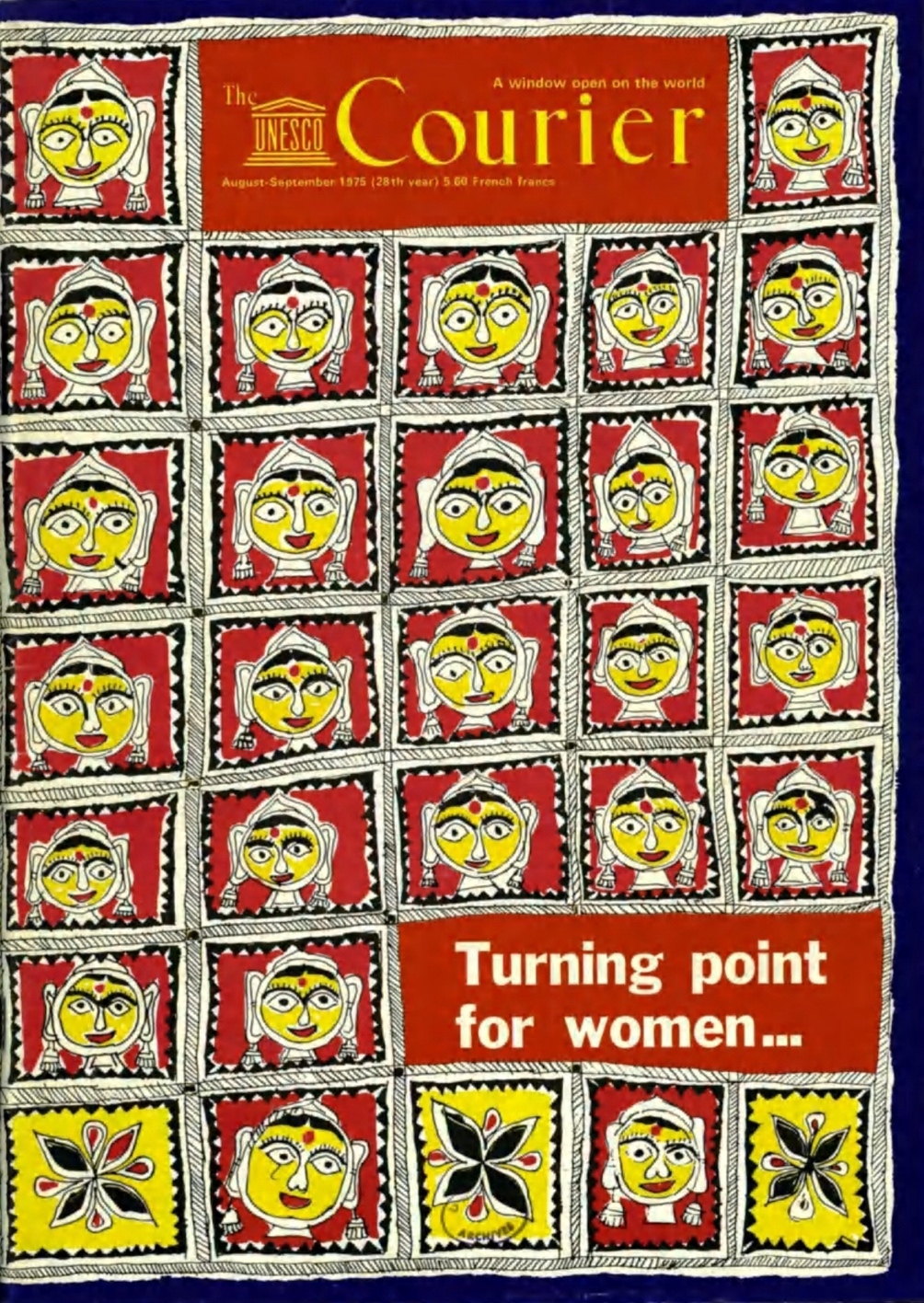
The United Nations designated 1975 as International Women’s Year, beginning the United Nations Decade for Women proclaimed after the first world conference on the status of women in 1975 in Mexico City (https://www.un.org/en/conferences/women/mexico-city1975). That same year, in Paris, Mithila paintings were displayed after the mounting of a successful exhibition of Véquaud’s collection at the Musée des Arts Décoratifs.[13] This convergence of dates contributed to the media visibility of the exhibition by playing on a transnational event, while also enhancing its success by situating it within a thematic resonance with ongoing developments in feminism. Significantly, a Mithila painting entitled Gopis,[14] depicting a series of fifty-nine nearly identical gopīs, is partially reproduced on the cover of the corresponding thematic issue of the UNESCO Courier, entitled Turning Point for Women . . . , depicted in Figure 1 (UNESCO 1975).
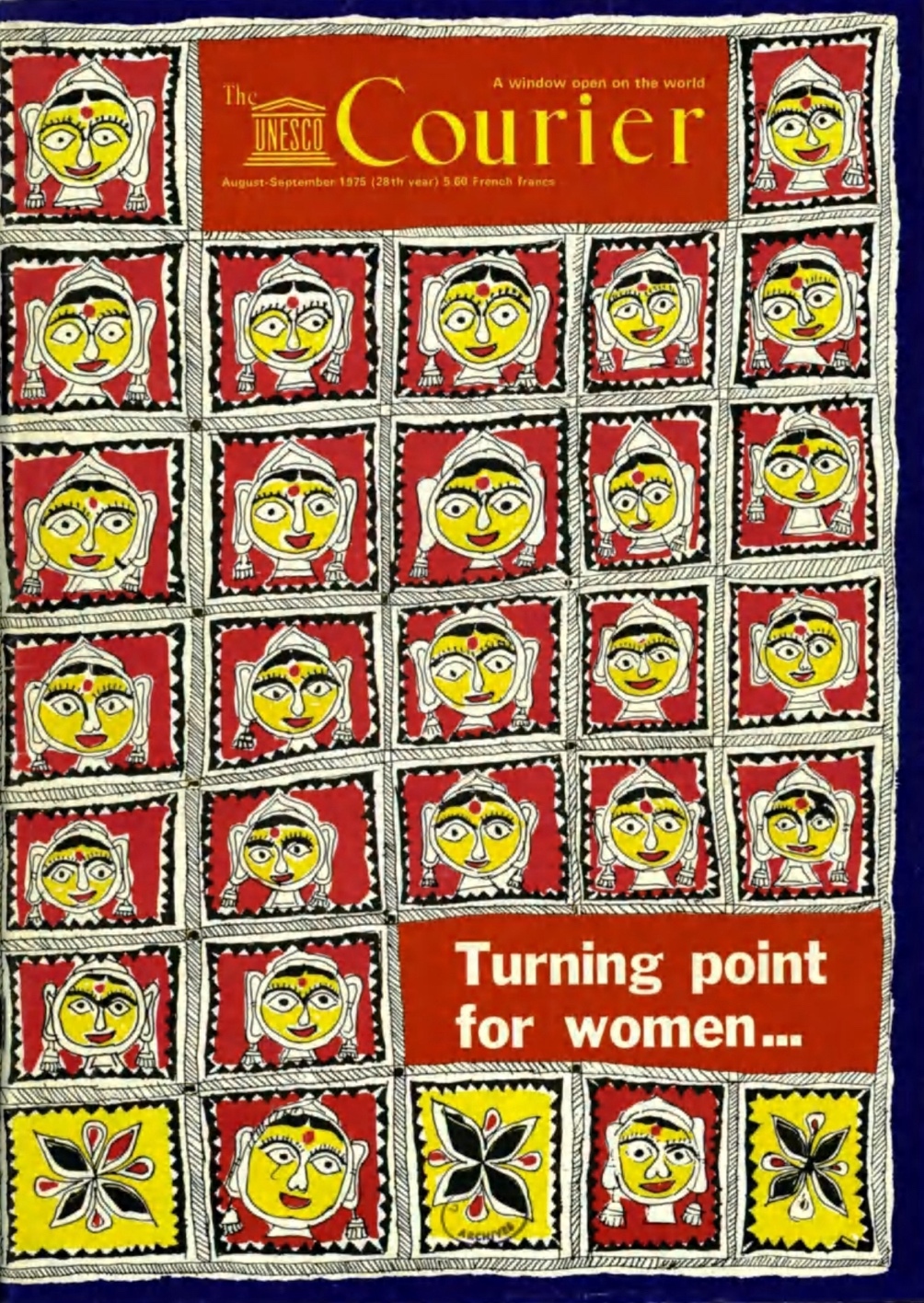
The cover image of the UNESCO Courier reproduces a painting known through a photograph of Véquaud’s collection exhibited at the Musée des Arts Décoratifs (Véquaud 1975).
The cover highlights the anonymous article called “Women Painters of Northern India” (UNESCO 1975, 34–38), which includes—the only color plates in the volume—six works from Véquaud’s collection (UNESCO 1975, 35–38). In this article, women painters are reduced to primitivist anonymity. Paradoxically, so is the author. The erasure of identity may be understood as symptomatic of the dominance of the institution—UNESCO—and of the concept of women’s emancipation, taking precedence over individual actors. Institutional logics and abstract concepts eclipse the individual artistic identities of the painters and the author’s status or auctoritas, relegating both grossly to anonymity.
Furthermore, UNESCO’s choice of the work featured on the front cover, which relies on the replication of analogous figures, may be compared to pop art paintings, thus enabling comparative analysis. In pop art, the serial and artificial character of a new visuality shaped by mass consumption is reproduced, yet the incorporation of variations renders it irreducible to mere reproduction. If “objects in consumer society are merely signs . . . of a rhetoric of functionality or commerce, if they never cease . . . to reproduce themselves” (Dauphin 2011, 110–11), pop art seems to do the same. However, pop art creates an ambivalent relationship with seriality, in which the aim is not to produce in series but to pretend to produce in series. Technical accidents become a means of accomplishing something else.
The same is true of the Gopis painting, where the overall effect of repetition is only apparent. A closer look at each gopī’s singular face reveals compositional diversification and attention to individual figures. What pop painting and this representation of Gopis have in common is that they both inscribe differences in repetition. They have recourse to seriality that breaks away from the logic of the “same,” introducing mutations within an imperfect mímêsis (Dauphin 2011, 110–11).
The selection of this painting for the UNESCO Courier may not be insignificant. Véquaud’s interest in modern art, combined with his ongoing interactions with Maithil painters, allows for the hypothesis that the serial depiction of gopīs in this work appealed to him through visual logics reminiscent of pop art. His artistic positioning would then be twofold: projective, based on formal comparisons devoid of context; and dialogical, emerging from a potential exchange with the painter whose work graced the cover.
Within the radical critique of alienation and the countercultural revolution of everyday life, the formation of groups for women’s emancipation and rights coincided with the emergence of a new kind of periodicals. The international reception of Mithila paintings is linked to the rise of feminist journals around the same time. Based on different visions of feminism, the inaugural issues of Heresies and EMMA appeared in Germany and the USA both in January 1977.[15] From the outset, each journal devoted an article to the women painters of Mithila: Stendhal’s (1977) contribution to EMMA in June 1977, and Moser-Schmitt’s (1977–1978) for Heresies in Winter 1977–1978. Their feminist connections will be explored further.
Dreaming Radical Feminism in Mithila and “Undoing Gender” with Mithila Painters? Artists as a Matriarchal Counter-Society in EMMA
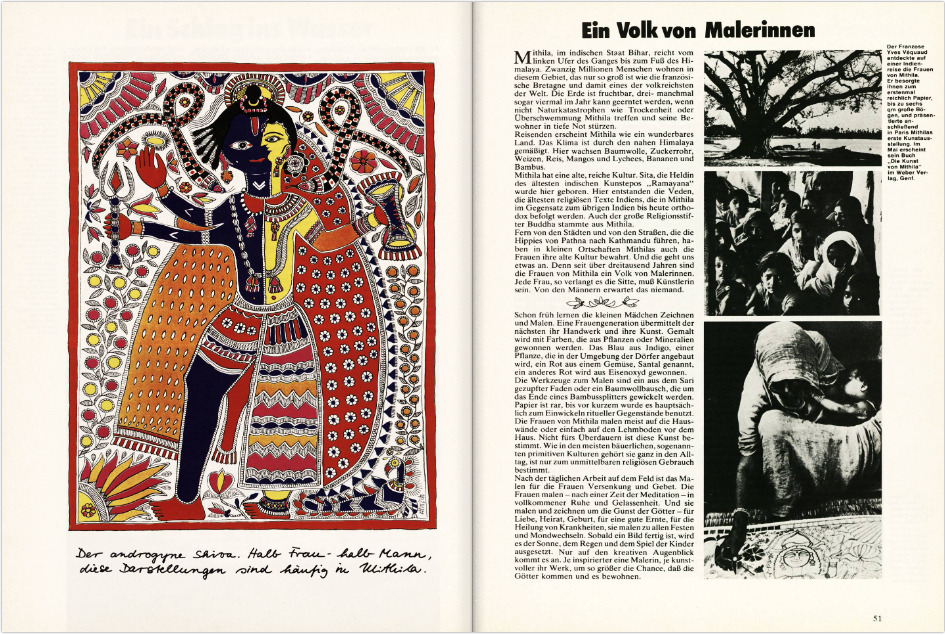
Launched with a print run of 300,000 copies, the feminist magazine EMMA became a major medium for disseminating the struggle for women’s emancipation and empowerment beyond the borders of Federal Republic of Germany. The name Alice Schwarzer (born 1942), author, activist, talk-show journalist, and founding chief editor of EMMA, is synonymous with this country’s “second-wave” feminist movement. Even the title of Stendhal’s article in EMMA describes Mithila society as Ein Volk von Malerinnen (“a people of women painters”), presented as a counterexample to patriarchal societies (Stendhal 1977, 51) (Figures 2 and 3).

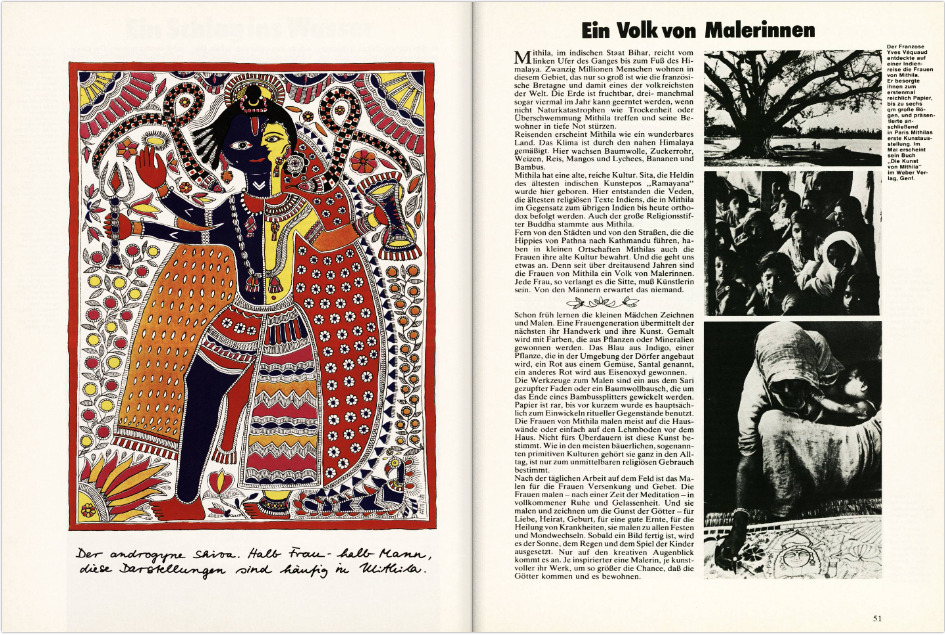
Stendhal’s training and professional trajectory have been marked by versatility, holding a doctorate in spiritual psychology, working as a therapist and teacher, while publishing both fiction and personal development books that explore feminist and lesbian themes. Most of her publications focus on the creative empowerment of women. Presumably Stendhal’s artistic training and the prevailing Indophilia of the period fostered her interest. The study on creativity as it relates to women’s emancipation constitutes a common theme linking Stendhal and Moser-Schmitt. Men have dominated the history of art, marginalizing women’s works. Valorizing women’s art is thus pioneering, following the countercultural rise of the feminist cause and gender evolutions. Both authors sought to rehabilitate women’s creativity. Moser-Schmitt questioned the monopoly granted to male artistic creation in dominant sexist interpretations, reducing women’s talent to imitation by obscuring their artistic singularity (Moser[-Schmitt] 1988).
Stendhal and Moser-Schmitt shared the conviction to restore an art history devoid of men’s creative monopoly. The theoretical convergence between the two could hypothesize for analogous visions concerning the women painters of Mithila. However, Stendhal’s article on Mithila art is based on Véquaud’s writings and repeats factual and interpretive errors founded on fanciful hermeneutics and the absence of rigorous ethnography (Brown 1982; Owens 1983). Stendhal’s utopian vision of a matriarchal counter-society and quasi-literal borrowings refer to the German translation of Véquaud’s L’art du Mithila (1977a), which she quoted, and whose forthcoming publication she heralded. As a Paris-based German journalist who had lived in France for years, Stendhal’s intercultural skills allowed her to learn about a French essay supporting her feminism.[16]
For Stendhal, Mithila exemplifies a form of equal rights and the elimination of de facto inequalities, insofar as the masculine and feminine, as the “two equal halves of a whole,” would never have been associated with the oppositions active–passive, positive–negative. Stendhal values the representation she describes as “hermaphroditic,” often present in Mithila art and illustrated in her article by the androgynous form of Shiva from the Véquaud collection. A similar representation of ardhanārīśvara, half Shiva and half Parvati, was used the same year by the Mithila painters as the logo of the Master Craftsmen’s Association of Mithila created in October 1977.
Representations of ardhanārīśvara are recurrent in the reception history of Mithila paintings, where they are reappropriated as symbols of gender complementarity, which is striking in the case of Stendhal. In the global market context and the wake of the feminist cause, the painting that is also titled Ardhanārīśvara is cited as a pioneering synthesis of an original intersex harmony, which suggests a projected commercial argument; that one of its justifications would be to meet the desiderata of non-Indian consumers, presumed to follow the values of a “mainstream” feminism. Stendhal proposes, in the wake of Véquaud, a phantasmagorical experience of gender resocialization, where the ardhanārīśvara symbolism would embody a fusion of sexual identities to go against the gender hierarchy attributed to “Western” culture. Such hierarchical dichotomies are presumed not to have any significant existence in Mithila. Through the prism of Stendhal’s projected presumptions, Mithila painters are cast in a bucolic utopia, where art symbolizes an ability to “undo gender.”
Following Véquaud (1977b, 9–31), including in terms of the layout of the images, Stendhal reproduces in her text black and white photographs by Boubat, five of the twelve of which appear in the introduction to The Art of Mithila. These two pages (Stendhal 1977, 51–52) are framed by color reproductions of Mithila paintings of the androgynous deity Ardhanārīśvara and Kali, both from Véquaud’s collection (Stendhal 1977, 50 and 53, respectively).
Like Véquaud, Stendhal depicts projected presumptions, which reveal more about gender dynamics and the extent of the feminist cause than about the women painters themselves. Stendhal’s hermeneutics bear witness to the perennity of primitivist topoi, reappropriated in radical feminism resonating with a countercultural ethos. These provide an original place for Mithila painters. This countercultural vision is opposed to a prevalent “Western” narrative, teleological, ethnocentric, and positivist, dominated by a linear vision of “progress,” which asserts a dominant Greek culture, predominantly masculine, to be the “cradle of the civilization.” The confrontation between gendered division and Western patriarchy versus harmonious non-division of the sexes and Indian matriarchy is ideological and political rather than cultural. Stendhal’s semantic register denotes this Maithil enchantment, instrumentalized to build a feminist utopia.
Stendhal’s promotion of the Ardhanārīśvara painting and Mithila painters constitutes an ideological critique of the Western patriarchy. Her utopian interpretation with a feminist-primitivist tonality in a countercultural context is “resistance in form and in idea” (Dagen 2021, 345–46) and the manifestation of an incidentally political revolt. Feminism, here reappropriated through the prism of the primitive, is an ideological weapon that is challenged by the dominant social order, the education system, and socio-aesthetic canons. While this primitivist feminism intended to be universalist, it actually perpetuates conformism and gender inequalities and sexist monopolies associated with the West. It is a form of opposition to the contemporary Western world, formalized in terms of gender relations. Primitivism was born out of a rejection of this Western world and can therefore be considered as political since at least the late nineteenth century.
The resonances between Stendhal’s and Véquaud’s writings constitute a system of intertextual relations. Stendhal’s article is also based on singular reappropriations of Véquaud’s writings. Véquaud begins his discussion in L’art du Mithila with a temporal and symbolic scale of multi-millennium ancientness, reflecting “folklorization” and a nostalgic quest for (re)constructed “authenticities.” He writes, “For about three thousand years, the women—and only the women—of Mithila have been making devotional paintings of the gods and goddesses of the Hindu pantheon” (Véquaud 1977b, 9).[17]
Stendhal uses terminology similar to the beginning of Véquaud’s L’art du Mithila when she writes, “. . . for over three thousand years, the women of Mithila have been a people of women painters. Every woman, according to custom, must be an artist. No one expects men to be artists” (Stendhal 1977, 50).
Through another intertextual link, Véquaud calls for leaving cities like Madhubani in pursuit of hamlets where Maithil civilization is presumed still alive. According to him, “Far from the cities and towns, and well off the route followed by ‘hippies’ from Patna to Katmandu, there are a few tiny villages, where these traditions remain alive” (Véquaud 1977b, 15).[18] Stendhal (1977, 50) asserts that: “Far from the cities and the roads that lead the hippies from Pathna [sic] to Kathmandu, in small villages of Mithila, the women have also preserved their ancient culture. And that’s our business.”
The beginning of the sentence by Stendhal is similar to the writing of Véquaud, but it then diverges. For Véquaud, reified, so-called pure traditions prevail, following the primitivist myth of unaltered alterity. Stendhal’s ambition consists in presenting an ideal counter-society in Mithila. Her utopia, conceived as concrete, but projective, is in her article a matter of “evidence,” supported by a presumed multi-millennial past:
It is therefore obvious that the women of Mithila have been artists for thousands of years. They are the only ones who have been trained in the spirit and technique of an art that magically creates the link with the gods. And since the artworks were never preserved, . . . each woman was left to express her image . . . according to her ideas and temperament. On the other hand, we women in our male-dominated culture have suffered from almost five thousand years of damaged self-confidence. Until recently, we were more likely to be honored as the artist’s muse, model, or self-sacrificing wife. There are of course reasons why the creativity of Mithila women is so evident. One can still find traces of female domination in Mithila today. (Stendhal 1977, 51)
Intertextual relations with Véquaud are also evident here but with a categorical character and the introduction of two binary oppositions: domination/emancipation and dominated/dominant culture. Stendhal’s dualistic analysis sets up women artists as a dominant social force, contrasting with the vision of (non-Indian) women “in our male-dominated culture” (Stendhal 1977, 51). The binary analysis in terms of power relations and gendered cultural domination does not appear in Véquaud’s work, which merely notes the paucity of women artists in Europe compared to the prolific art expressions of women painters in Mithila. If the relations of intertextuality and visual correspondences build common modes of idealization, the ambitions of the two authors diverge in their contrasting finalities.
Mithila Woman Painters in Heresies: The Assertion of Moser-Schmitt’s Inclusive Radical Feminism
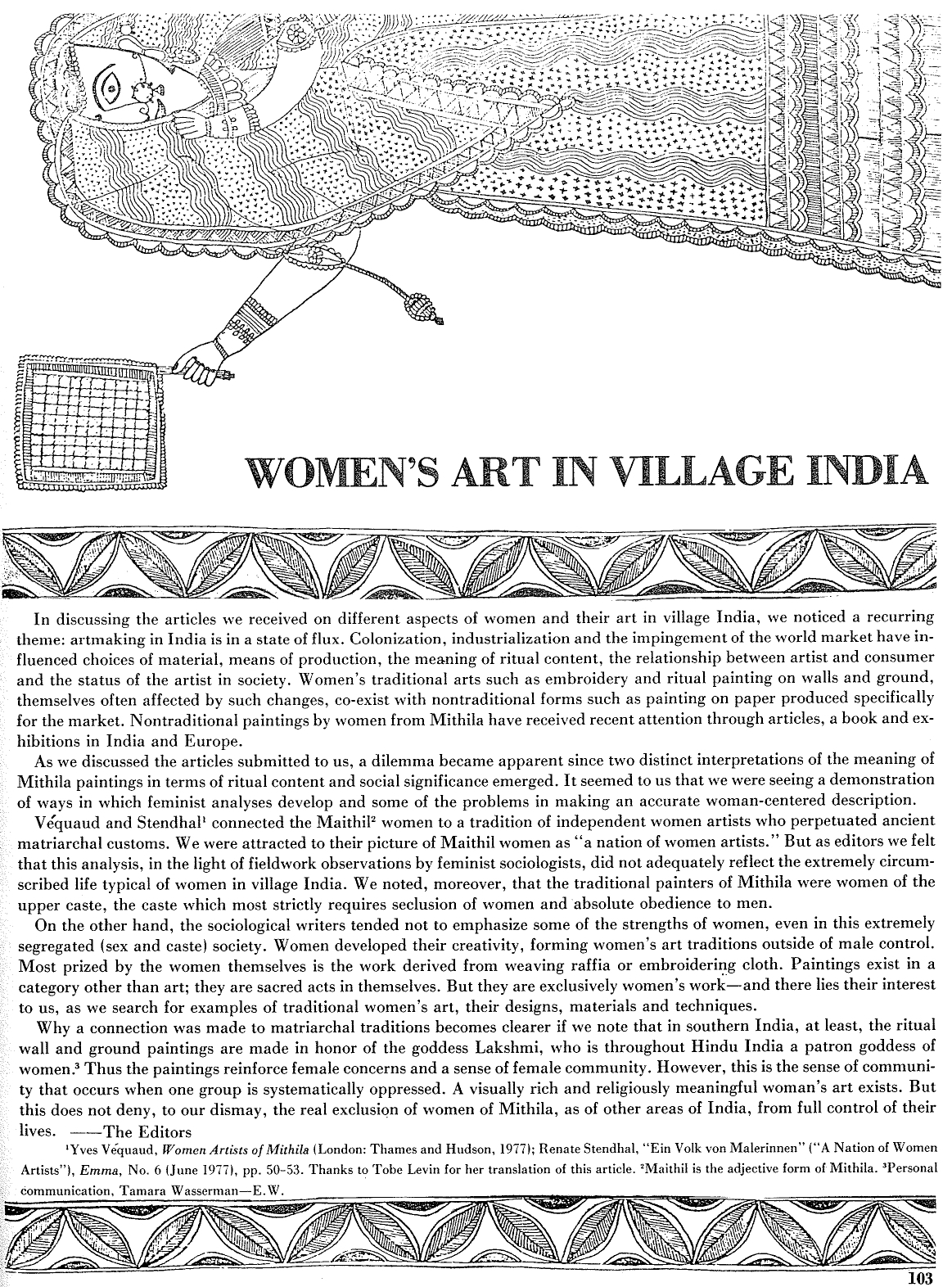
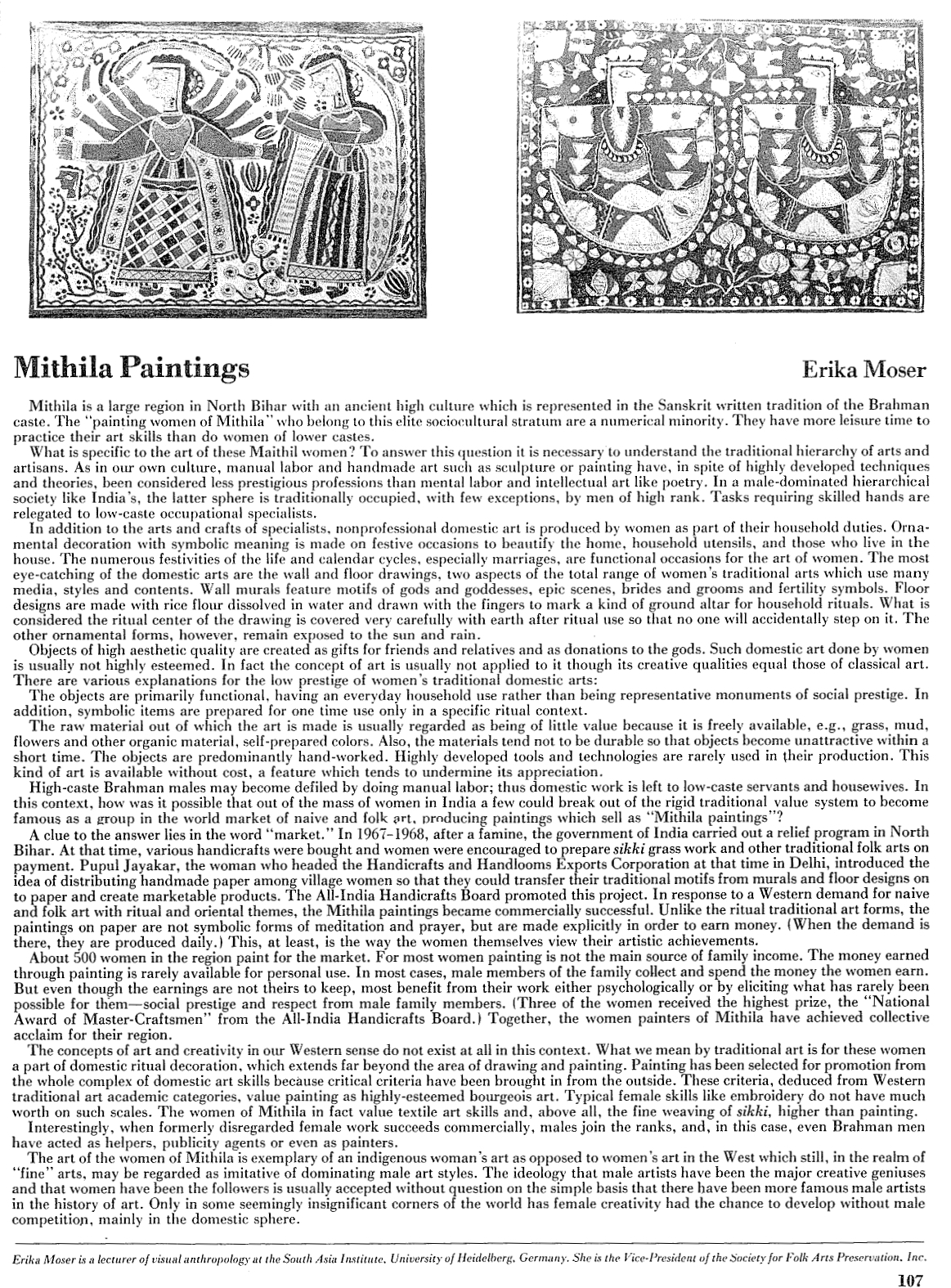
The vision of Maithil society as a matriarchy is one of the (mis)interpretations reflected in the writings of Véquaud and Stendhal. A divergent interpretation of Mithila emerges in a subsection of the issue of Heresies on women’s arts in village India, to which Moser-Schmitt contributes (Heresies Editorial Group 1977–1978d, 103; Moser[-Schmitt] 1977–1978, 107) (Figures 4–6). Although the editors of Heresies were attracted to Véquaud’s and Stendhal’s picture of Maithil women as “a nation of women artists,” they felt that “this analysis, in the light of fieldwork observations by feminist sociologists” (Heresies Editorial Group 1977–1978d, 103), did not reflect the common circumscribed life of women in village India. The Heresies Editorial Group (1977–1978d, 103) notes that the dominant caste, from which many painters came at first, requires the strictest “seclusion of women” in conformity with pardā, less respected in the dominated Dalit castes, due to strategies of survival beyond genders. For the Heresies Editorial Group, these interpretations reveal “two distinct interpretations,” reflecting the divergent trajectories of feminist studies shaped by the contrast between inclusive and exclusive, dialogical and binary perspectives:
As we discussed the articles submitted to us, a dilemma became apparent since two distinct interpretations of the meaning of Mithila paintings . . . emerged. . . . We were attracted to . . . [Véquaud’s and Stendhal’s] picture of Maithil women as “a nation of women artists.” But as editors we felt that this analysis . . . did not adequately reflect the extremely circumscribed life typical of women in village India. We noted . . . that the . . . painters of Mithila were women of the upper caste, . . . which most strictly requires . . . absolute obedience to men. . . . The sociological writers tended not to emphasize some of the strengths of women, even in this extremely segregated (sex and caste) society. Women develop their creativity, forming women’s art tradition outside of the male control. (Heresies Editorial Group 1977–1978d, 103)

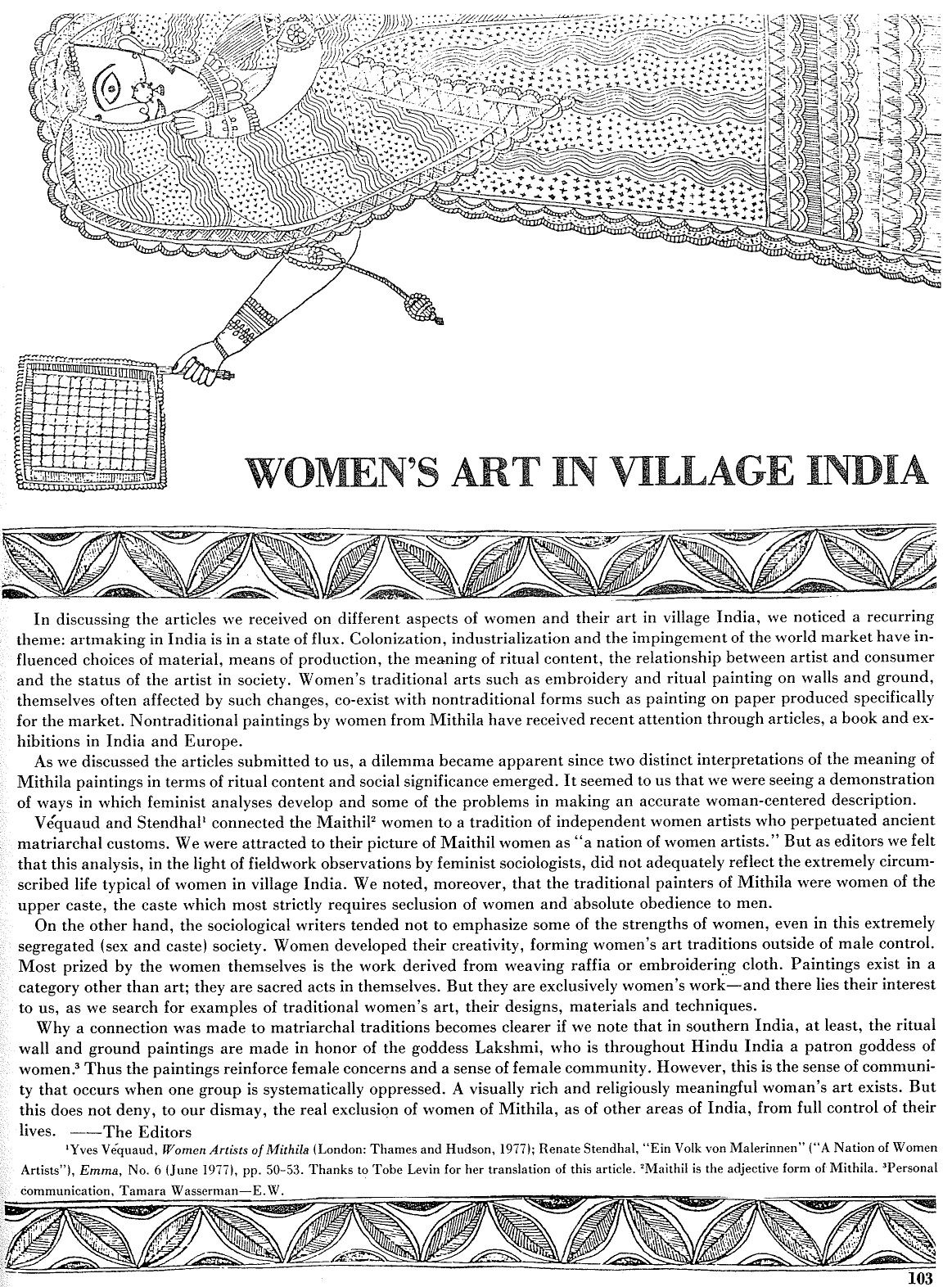
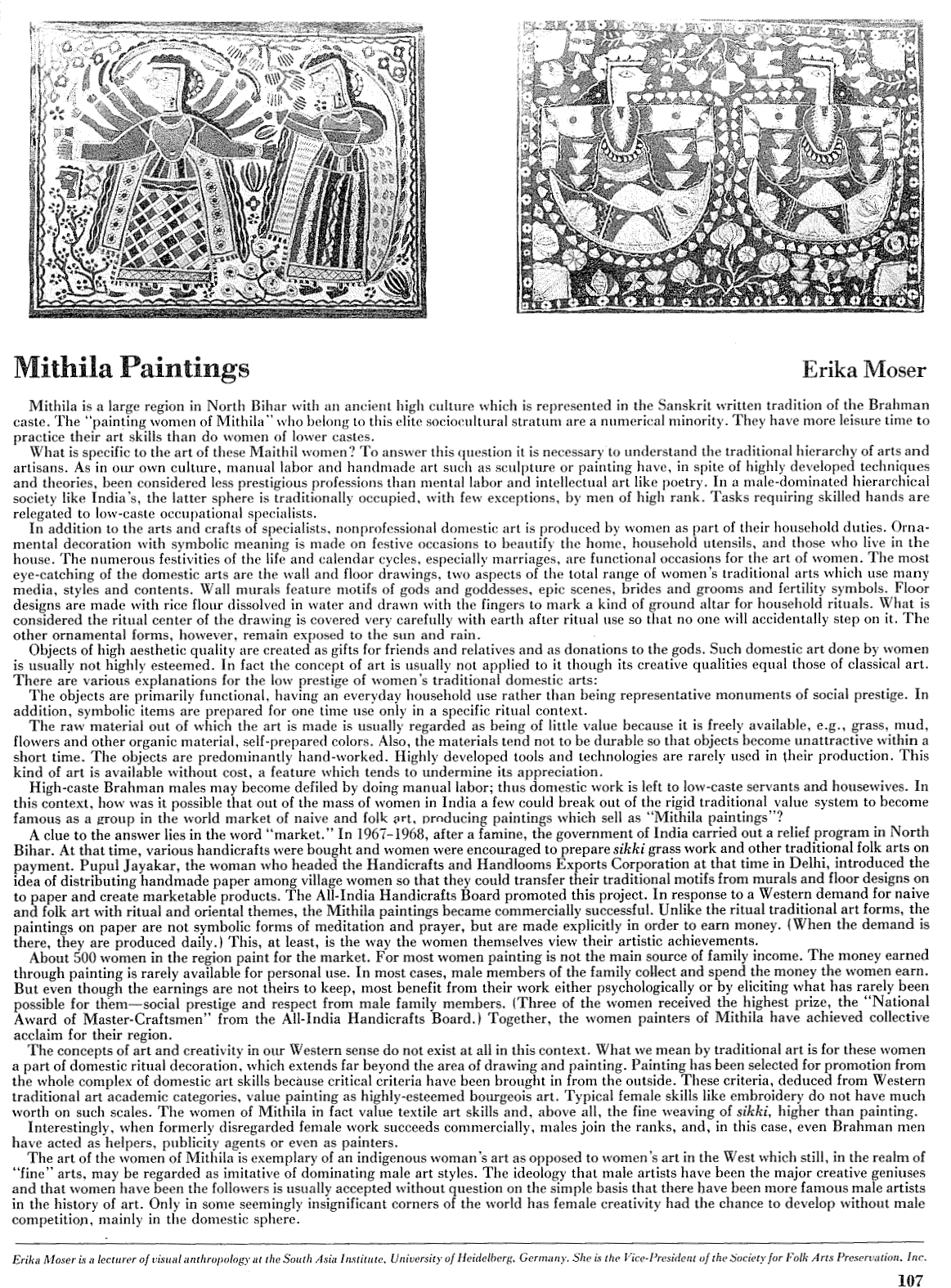
The introduction to the fourth issue of Heresies, devoted to Women’s Traditional Arts, attests to an experimental and pioneer positioning, combined with a critical approach, coupled with self-reflexivity. To introduce this thematic issue, which focuses on women’s art from a global perspective, the Heresies Editorial Group expresses itself as follows:
Women’s Traditional Arts? . . . Criticism and self-criticism were the feedback structures that allowed us . . . to re-examine our process and our ideas. . . . In order to understand women’s traditional arts and our responses to it we had to deconstruct and reconstruct to be able to see . . . the interrelationships between art objects and the conditions in which they are produced. This cycle of dismantling and re-creating characterized our own creative process too. (Heresies Editorial Group 1977–1978a, 2)
This manifesto-like introduction conveys the journal’s inclusive feminist vision, characterized by a capacity to apprehend interactions to avoid reductive dualisms. Heresies examines “art and politics from a feminist perspective,” to stimulate dialogue around a “radical political and aesthetic theory,” write the history of “femina sapiens” and boost “new creative energies” and a “socialist feminism.” This manifesto and its call to think of art as political shows the centrality of the countercultural ethos in 1960s activist circles (Heresies Editorial Group 1977–1978b).
Stendhal and Moser-Schmitt developed antagonistic visions of the women painters and their creative and social contexts. By essentializing the painters’ creativity, Stendhal limited herself to the presumed matriarchal character, attributed by Véquaud to Mithila. Presenting the latter as a counterexample to patriarchal society evokes a reified conception of feminism. For Stendhal, gendered identities and dominations were opposed in a binary mode.
In contrast, Moser-Schmitt superimposed issues of caste and class on the critique of patriarchy. Her pioneering combination of subalternization criteria forms a proto-intersectional feminism. As previously mentioned, following her, Brahmin women have a threefold advantage over their Dalit counterparts, who are more often forced into survival logics, which prevail over patriarchal gender imperatives.
Moser-Schmitt documented women’s creative performances, contrary to the persistent gender prejudices widely shared among communities at opposite poles of the caste system, such as Maithil Brahmin[19] versus Dalit (Dusādh and Chamār).[20] She represented a cross-community dimension in art. Despite their talent and mastery of techniques, the skills of women painters tended not to be fully recognized in Mithila before their rise in the trans-local art market.
For Moser-Schmitt, women are in a situation of subalternity correlative to patriarchal dimensions, mixed with forms of assertion and emancipation. Their works, in a subaltern ritual context, are considered a vernacular practice with limited prestige. For Moser[-Schmitt] (1977–1978, 107), “the concept of art is usually not applied to it [this art] though its creative qualities equal those of classical art.” Therefore, she gives explanations, superimposing criteria contributing to the subalternization of this practice. Regarding the domestic nature of this art, she makes several assertions:
In addition to the arts and crafts of specialists, non-professional domestic art is produced by women as part of their household duties. Ornamental decoration with symbolic meaning is made on festive occasions to beautify the home . . . and those who live in the house. The numerous festivities of the life and calendar cycles, especially marriages, are functional occasions of the art of women. . . . Objects of high aesthetic quality are created as gifts . . . for relatives and as donations to the gods. Such domestic art done by women is usually not highly esteemed. In fact the concept of art is usually not applied to it though its creative qualities equal those of classical art. There are various explanations for the low prestige of women’s traditional domestic arts. (Moser[-Schmitt] 1977–1978, 107)
Considering the domestic function of this art, Moser-Schmitt observes, “The objects are primarily functional, having an everyday household use rather than being representative monuments of social prestige. In addition, symbolic items are prepared for one time use only in a specific ritual context” (Moser[-Schmitt] 1977–1978, 107).
Regarding the freely available nature of the materials, and the ephemeral and non-commercial character of the murals contributing to their value depreciation in local circles, she writes, “The raw material out of which the art is made is usually regarded as being of little value because it is freely available . . . . Also, the materials tend not to be durable so that objects become unattractive within a short time. The objects are predominantly hand-worked. Highly developed tools and technologies are rarely used in their production” Moser[-Schmitt] (1977–1978, 107).
Ritual domestic frescoes are therefore created with a double deficit of capital: symbolic-religious and economic-monetary. Moser-Schmitt’s 1977 ethnographic observations precede and confirm those published by Brown-Heinz (Brown 1996; Brown-Heinz 2006).
Moser-Schmitt concludes with a paradox. The overlapping marginalization forms of Mithila art on the local scene create the conditions for women’s creative emancipation, precisely because it is circumscribed to the domestic sphere:
The ideology that male artists have been the major creative geniuses and that women have been the followers is usually accepted without question on the simple basis that there have been more famous male artists in the history of art. Only in some seemingly insignificant corners of the world has female creativity had the chance to develop without male competition, mainly in the domestic sphere. (Moser[-Schmitt] 1977–1978, 107)
Moser-Schmitt agrees with the Heresies Editorial Group’s (1977–1978d, 103) idea that women develop their creativity outside of male control.
The commercialization of Mithila paintings represents a turning point in their history. As noted, as women’s non-Sanskritic domestic rituals, murals remain at the margins of Brahminical values.
Through the artified commercialization of paintings transferred to paper, some women managed to improve their socioeconomic and gender status. Following the Heresies Editorial Group, Moser-Schmitt was less concerned with determining a pseudo-artistic essence than with deconstructing a creative process, from ritualistic murals devoid of market value to symbolic and economic recognition within a trans-local art market. Moser-Schmitt’s questioning highlights the paradox facing the globalization of Mithila art. She asks,
was it possible that out of the mass of women in India a few could break out of the rigid traditional value system to become famous as a group in the world market of naive and folk art, producing paintings which sell as “Mithila paintings”? (Moser[-Schmitt] 1977–1978, 107)
That is, under what conditions do works and artists enter the contemporary scene to build international careers? “The clue to the answer,” by Moser[-Schmitt] (1977–1978), “lies in the word [art] market.” Although partially refutable—the market does not necessarily entail social improvement—this complex and evolving vision of Mithila anticipates later feminist and critical approaches to painters and paintings. Far from an essentialized conception of “tradition,” Moser-Schmitt’s vision is part of a dynamic approach, subject to interrogation and reconfiguration, in relation to the evolving state of the art.
By situating Mithila paintings’ production within the dynamics of the market, Moser-Schmitt articulates a more complex and nuanced vision than Stendhal’s. Moser[-Schmitt] (1977–1978, 107) presented two examples of painters: those—the majority—who cannot directly dispose of the income from the sale of their paintings, because male family members collect and spend it; and those—the fewest—who are more successful, become transnational “celebrities,” and benefit from greater power. Men, including Brahmins, often engage in various profit-generating aspects of the activity. Art globalization fostered their emergence as commercial brokers, assistants, and painters. For Moser-Schmitt, the transformation of the socioeconomic environment can overturn the gendered division of labor. For most women painters, it is possible to observe a mixed confiscation of income diverted to the family group and a gain in status and respect from the same group. Moser-Schmitt highlights the superimposition of patriarchal structures and novel forms of empowerment:
About 500 women in the region paint for the market. For most women painting is not the main source of family income. The money earned through painting is rarely available for personal use. . . . Male members of the family collect and spend the money the women earn. But . . . most benefit from their work either psychologically or by eliciting what has rarely been possible for them—social prestige and respect from male family members. (Three of the women received the highest prize, the “National Award of Master Craftsmen” . . . ) The women painters of Mithila have achieved collective acclaim for their region. (Moser[-Schmitt] 1977–1978, 107)
Moser-Schmitt recognizes the constructed nature of transferring the paintings to paper for commercialization and the differentiated value scales and criteria of appreciation between painters and buyers, especially non-Maithils.
It is through the prism of a Western gaze that the works are reconfigured for inclusion in the art sphere, albeit partially: ethnocentric and reified forms of appreciation, combined with the quest for supposed “authenticity,” tend to obscure the dimension of art contemporaneity at work in this creative process. The paintings tend to be confined to the status of “popular art.” This non-Maithil recategorization follows criteria rooted in Western art history, imbued with a bourgeois habitus: hanging of the paintings on the wall, and even their framing, as modes of valorization. Faced with the buyers’ aesthetic vision, the painters privileged the domestic function of the paintings, be it ritual or decorative. Moser[-Schmitt] (1977–1978, 107) transcribed the painters’ appreciation criteria: “women of Mithila [in the 1970s] value textile art skills and the fine weaving of sikkī grass, higher than painting.” Sikkī grass is a variety of plant or grass common in Bihar that can be woven into wickerwork known internationally as sikkiware. Moser[-Schmitt] (1977–1978, 107) relativized the art dealers and merchant aesthetic criteria as “deduced from Western tradition art academic categories, valu[ing] painting as highly-esteemed bourgeois art.”
Although Moser-Schmitt intersected the perspectives of painters and art connoisseurs and underlined discrepancies in the inter-area criteria of appreciation, her perspective, as an observer, was not fixed. She did not always present a single point of view. Her view varied according to the instance of diffusion and the results of her research. The illustrations in the commentary of her film D1196 show a different level of reading than her article for Heresies: while the latter opposes high-caste men to women, the duo illustrations in the film commentary underlines the discrepancy between the situation of Dalit and Brahmin women (Moser[-Schmitt] 1978). Her article for Heresies contrasts men and women, while the duo illustrations of her film underline the unequal distribution of artistic recognition correlated to dominant versus dominated castes. For Heresies, Moser-Schmitt focused on gender inequalities. Beyond their differences, these two approaches are complementary. The following quotation from the Heresies Editorial Group can be applied to Moser-Schmitt’s writings on Mithila painters: “word and image can be equal ingredients in politically effective art,” implying that “there are . . . few ‘illustrations’ here, but independent statements expressed visually, verbally, or in combination, sharing the same power and the same intent” (Braderman et al. 1977, 2–3).
An intermedial approach, producing meaning through the convergence of different media, reveals tensions in Moser-Schmitt’s work across multiple configurations of subalternity, structured on oppositional binarities of dominant/dominated and inclusive/exclusive between Brahmin and Dalit women, but also between Brahmin men and women, irrespective of caste. In the Heresies article, criticism concerns Brahmin men, sparing those of the scheduled castes, as they are also undergoing dominations. The complexity of Moser-Schmitt’s “moving” discourse on issues of subalternity is in line with the critical positioning, mixing feminism and social issues of Heresies. Through this discourse, superimposing criteria of caste and class discriminations, socio-spatial inequalities (rural versus urban), and worldwide regional cleavages (Global South versus Global North), she situated the study of Mithila painters in the turn of feminist studies, precisely brought about by this journal. The collective climate of revolt and emancipation during the Long Global Sixties, in which Heresies was embedded, sought to reveal the arbitrariness of the foundations of the social order, associated—in the case of the inclusive feminism championed here—with inequalities of gender, religion, class, and North/South cleavages.
EMMA, whose editor-in-chief Alice Schwarzer is close to the Women’s Liberation Movement, is part of an exclusive radical feminism based on the fight against patriarchy. Heresies started from an inclusive radical feminism—which defined itself as “true socialist internationalist antiracist anti-heterosexist feminism”—open to ecofeminism from the early 1980s.[21] Despite differences in historical context, the vision of Heresies resonates with recent trends in intersectional feminism, as exemplified by Feminism for the 99% (Arruzza et al. 2019). This contemporaneous development, coexisting with other currents (for example, those more attached to male/female binarity), is grounded in the plurality of identities and opposition to intersecting forms of oppression. Intersectional feminism falls in the latter category. Although the language of “intersectional feminism” emerged in the 1990s, it is powerfully articulated in the women’s strikes of the late 2010s (in Argentina, Poland, and the USA, among others), which foreground a convergence of struggles, linking feminist demands to other contemporary fights deemed essential, as anti-capitalism, anti-racism, political ecology, internationalism, or anti-heterosexism.
From the early 1970s, Moser-Schmitt shared the orientation of Heresies toward intersectionality. Mithila’s women painters, as mediated through the EMMA and Heresies articles, mark a key turning point in history of feminism, as it is revealed in the passage from Véquaud’s vision—via Stendhal—to Moser-Schmitt’s. Only a few months separate the June 1977 issue of EMMA, including Stendhal’s article, from the Winter 1977–1978 issue of Heresies, presenting Moser-Schmitt’s article, and the two thus elaborate a contrasting dialogue through interposed reviews around a now globalized Maithil art.
One key stake in studying the international reception of Mithila paintings lies in writing a connected history within the framework of critical Mithila Studies. From this perspective, the 1970s emerge as a kairos—an opportune moment in the reception of Mithila art—marking its globalization in a space where the trans-local intersects with the transareal. The resulting polyphony of overlapping narratives subsequently serves political discourses largely exogenous to the Maithil painters’ creative contexts.
On the notion of critical years, see Gobille (2018, 372): “la domination médiatique de la doxa libérale et conservatrice et de la pensée anti-68, n’en finissent pas de solder—pour combien de temps encore?—les ‘années critiques.’”
In the context of text interpretation, semantization refers to construction of meaning to a word or syntactic structure. Re-semantization signifies the re-interpretation of these elements. Here, the terms “re-semantization” apply to textual and cultural elements. This is exemplified by the reconstruction of the meaning attributed to paintings through their globalized reception, with the emergence of criteria of appreciation. Within their international circulation, they gain new legitimacies, according to paradigms of meaning, which can influence their forms of reception and consecration. Decontextualized on the globalized scene, the works are reinterpreted through paradigms external to Mithila by transcultural mediators. The paintings follow on the heels of new settings to fit into economic, cultural, and/or ideological needs and consumerist desiderata of non-Maithils, primarily Westerners, constituting the audience and consumers of a global market.
Similarly termed in French as Longues années 1960 (Kornetis 2017, 186), the notion of “Long Global Sixties” can be defined as a wider set of contestations than the events of 1968, which emerged worldwide in the mid-1950s, accelerated in the 1960s, and decelerated unequally in the 1970s (Fletcher 2018, 8). This notion is quite similar to that of “Long May 68.”
The use of the term “subalternization” as a process appears in recent works within subaltern studies. According to Thomas (2018, 876), “Subalternization, conceived in terms of ‘minoritarization,’ . . . represent[s] a primary experience of exclusion, oppression, and marginalization.” See also Arias (2015) and Spivak (2017).
In accordance with pardā, prevalent among the dominant castes in North India, women are subject to rules of seclusion: access to adult men from outside the home is forbidden, especially in the zenānā, the part of the home reserved for them. Women are pardā niśīm, sitting behind the curtain. Physical segregation between the sexes prevails.
Aripanas are floor paintings created on samskaras or other ceremonial occasions. They are executed with a paste made from ground rice, and sometimes incorporate rice powder, flowers, sandalwood paste, and vermilion, and are executed and drawn using a small twig or the fingers as a brush. They often take the form of stylized floral motifs or semi-geometric diagrams, at the center of which a sacred object (such as a pot, plate, basket, or seat) is placed and used in the performance of the ritual. More complex designs and elaborate compositions are punctuated with vermilion dots and frequently represent a flower, a lotus, or other auspicious vegetal forms. Ephemeral creations, like wall paintings, these motifs and drawings project into space the meaning of a moment defined by the ritual calendar. Their significance lies less in their permanence than in their role as ritual diagrams that materialize the auspiciousness and cosmological order of a specific ceremonial moment.
Ritual objects are included in the sphere of art, reified, yet detached from their cultural context, or following Price (1991, 4–5), clarifying this type of primitivist quest for aesthetic contemplation: “It deals . . . with some of our most . . . unquestioned cultural assumptions . . . about the boundaries between ‘us’ and ‘them’. . . . [T]his book is about the plight of objects from around the world that—in some ways like the Africans who were . . . transported to unknown lands during the slave trade—have been discovered, seized, commoditized, stripped of their social ties, redefined in new settings, and reconceptualized to fit into the economic, cultural, political, and ideological needs of people from distant societies.”
William G. Archer (1907–1979) studied history and law in Cambridge, joined the Indian Civil Service in 1931, and was appointed to Bihar, where he served for fifteen years. He was posted as subdivisional officer to Madhubani (Dharbanga subdivision, 1933–1934). Specialist in Indian art and essayist, he became responsible for the Indian section of the Victoria and Albert Museum in London (1949–ca.1959). His writings, as his article “Maithil Painting” (W. Archer 1949), are underpinned by a universal aesthetics, based on psychoanalysis and surrealism vanguards. He works out a Eurocentric aesthetics, stemming from colonialism, vanguards, and an organic vision of art.
W. Archer (1949) provides a nuanced understanding of the caste stylistic distribution, which he extends to a regionally endemic trans-caste mural practice. He notes that, throughout the region, the paintings of one caste express a similar series of values but use only approximately the same idioms and methods. W. Archer (1949, 25) thus writes: “Maithil Brahmins and Maithil Kayasths are those in whom painting is most highly developed. It is true that Rajputs, Sonars, Ahirs and Dusadhs also do painting and it is almost as if painting is endemic to the region.” Documents in the Archer Collection (British Library), provide also evidence of a wider proportion of castes creating wall frescoes (Fleury 2018, 227–28).
With her early training in the visual arts, while William’s first aspirations were literary, Mildred stimulated the visual turn at work in their publications from their return to Britain (1948), when both became common curators in British cultural institutions. She also developed her own interpretation of Mithila paintings, notably in Indian Popular Painting (M. Archer 1977).
The Heresies editorial collective defines itself as experimental: “HERESIES is an idea-oriented journal devoted to the examination of art and politics from a feminist perspective. We believe that what is commonly called art can have a political impact, and that in the making of art and of all cultural artifacts our identities as women play a distinct role. We hope that HERESIES will stimulate dialogue around radical political and aesthetic theory, encourage the writing of the history of femina sapiens, and generate new creative energies among women. HERESIES is structured as a collective of feminists, some of whom are also socialists, marxists, lesbian feminists or anarchists; . . . Our view of feminism is one of process and change, and we feel that in the process of this dialogue we can foster a change in the meaning of art” (Heresies Editorial Group 1977–1978b).
The other contributors include Indian agents of the All-India Handicrafts Board, Bharat Sahay and H. P. Mishra; Raymond Owens, attached to Rajshahi University in Bangladesh; Indian mediators Gauri Mishra, Subodh Jha, and Bhaskar Kulkarni; and Maithil artists Jamuna Devi, Sita Devi, Mahasundari Devi, Baua Devi, and Ganga Devi.
Mithila, les femmes, leurs peintures et la faveur des dieux, Musée des Arts décoratifs, Pavillon de Marsan, Louvre, from March 21 to May 19, 1975. Chief curator: François Mathey. Administrative manager: Odile Kammerer.
The gopīs are female herders of revered bovines and the cowherd deity Krishna commonly enthralls them by playing the flute while they dance, signifying the Rāsalīlā—a consistent motif in Mithila art.
Heresies was first published in January 1977 (The Heretics, n.d.). Although EMMA’s first issue is dated February 1977 (EMMA, n.d.), the first print run actually took place on January 26, 1977 (EMMA 2017). The two feminist periodicals began to be edited simultaneously.
In 1970, Stendhal became, for several years, a personal assistant in Paris to the Swiss writer and surrealist painter, Meret Oppenheim. From 1975 to 1982, she was a cultural correspondent in Paris for German media, including Frankfurter Rundschau.
See also Véquaud 1977a, 11, 1973, 75.
The Maithil Brahmins form one of the privileged and dominant castes in Northern India (forward castes), which since the Raj have included the largest landowners. With the Bhumihars, Rajputs, and Kayasths, the Maithil Brahmins constitute the four dominant castes in Bihar, representing 12% of the population in 2013 (Brown-Heinz 2013, 32–33). Since the fourteenth-century Muslim invasions, Mithila has long been dominated by the Maithil Brahmins. They have forged a history of cultural and intellectual patronage perpetuating a conservatist Brahmanic rootedness. The royal family of the Darbhanga Raj belongs to the Maithil Brahmin caste, and was the most prosperous zamīndārīs in northern Bihar.
Ex-Harijans and ex-Untouchables, the Dusadh and Chamar are the names of two scheduled castes. Tending to call themselves Dalits, or the “oppressed,” they are well established in North India. Mainly pig breeders, agricultural workers, or specialists in leather work, Dalits are often relegated to endemic extreme poverty. They are not authorized by the Brahmins to live in the heart of the villages and gather in specific districts (toli).
In the field of ecofeminism, which really developed in the 1980s, Heresies devoted an issue (4, no. 1) to Feminism and Ecology in 1981. Ecofeminism goes against the domination of men over women and that of humans over nature. Introduced by Françoise d’Eaubonne in 1974, the movement emerged in the 1980s in the Anglophone world (Larrère 2012).